
Franklin County Criminal Docket Searches
For a Superior felony, open at the county's official Court Dockets landing page. Fair warning: its clerk link can drop you into a legacy iframe wrapper. That wrapper redirects to a login. A dead end there means nothing. The steadier route runs through Georgia Courts E-Access. There you pick Franklin Superior and continue into PeachCourt. Georgia Courts notes that an account is required. Inside PeachCourt, the Cases search fits a party or court case number. The Filings search only helps when you already hold a Peach number.
Use the exact case number from a notice whenever you can. Franklin County publishes no local prefix guide. Rule 36.9 builds a Superior case number from filing year, case type, sequence, and judge assignment where required. Guessing punctuation or a prefix invites errors. A careful party-name search can still work. Just check each hit against Franklin Superior Court, the caption, filing date, assigned judge, and status.
- Confirm that Franklin Superior Court filed the matter.
- Select Franklin County and the Superior Court in PeachCourt.
- Enter the exact case number, or search a carefully checked party name.
- Compare the case header, charge entries, settings, and latest disposition.
- Ask the responsible clerk for an official document when the docket link is unavailable.
Franklin County Criminal Docket Portal
PeachCourt is Franklin Superior Court's provider for these court records. The PeachCourt provider home lays out the service that participating Georgia courts use for records and e-filing.

A provider login is only the doorway, not the whole Franklin County criminal file. The docket may list an event. But the file-stamped indictment, sentence, or order stays account controlled, delayed, or absent from the online record.
Blank results? Check spelling, the court you selected, and the exact number format before concluding anything. Heather Vaughn Hill, Clerk of Superior and Juvenile Courts, takes calls at 706-384-2514. Visit the office at 9592 Lavonia Road in Carnesville. Hours run Monday through Friday, 8:00 a.m. to 5:00 p.m. Mail goes to PO Box 70, Carnesville, GA 30521. These direct channels also serve older records and certified copies.
Criminal Dockets: What They Show
Read a Franklin County criminal docket as a timeline. The header gives the court and case; the dated register of actions carries the story. The charge is not the disposition. An indictment or accusation names the formal charge, and only a later plea, verdict, dismissal, or nolle prosequi records what happened. Settings can move without ending anything.
| Header | Franklin Superior Court, case number, filing date, caption, judge, and current status. |
|---|---|
| Charge | Count, offense description, indictment or accusation date, and bond or capias details when public. |
| Events | Dated filings, motions, orders, filer details, clerk acceptance, and available document links. |
| Settings | Arraignment, hearing, trial, sentencing, or review date, with the newest order controlling. |
| Disposition | Plea, verdict, dismissal, nolle prosequi, sentence, appeal, or restriction indicator. |
When public, entries may also cover attorney information, costs, probation, restitution, remittitur, and post-disposition events. Treat the docket as an index and procedural history. It is no substitute for a criminal-history report, and it can change after an appeal or later order.
Franklin County Criminal Docket Results
Pair the charging entry with the final event. "Pending" simply means no result yet. A guilty plea is not a conviction after trial. An acquittal is not a dismissal. When the prosecutor formally drops a charge, the docket says "nolle prosequi." The phrase is often shortened to "nol pross." A capias orders arrest or custody, usually after a failure to appear or another authorized event.
- Arraignment
- The hearing where the charge is stated and a plea is entered.
- Disposition
- The recorded result for the case or a specific count.
- Continuance or reset
- A moved court setting, not a final outcome.
- Nolle prosequi
- A prosecutor's formal decision not to continue a charge.
- Restricted
- Access limited by law, court order, or protected-information rules.
Franklin County publishes no current local disposition-code list. Treat any abbreviation as a prompt to open the full entry or ask the clerk. Guessing a result from it is risky.
Criminal Case Stages on the Docket
A Superior criminal case unfolds through dated entries, not one summary line. The docket may open with an indictment or accusation, then show bond or capias activity. Arraignment adds a plea. Pretrial entries often carry motions, orders, notices, and changed settings. A plea or trial brings disposition and, where applicable, sentencing, while appeals and later orders can add entries after the first judgment.
Docket flow: Charge Filed › Arraignment › Pretrial › Plea or Trial › Disposition › Sentencing
The Northern Judicial Circuit's three Superior judges hold criminal hearings and jury or non-jury trials across five counties, including Franklin County. Because judges travel, trust the newest setting or order. An older date stays in the history even after the hearing is reset.
Franklin County Criminal Docket Split
Superior Court does not hold every Franklin County criminal matter. Warrants and limited misdemeanors land in Magistrate Court among its listed functions. Probate Court may conduct criminal preliminary hearings. It can also hear some misdemeanors and traffic cases, unless a jury trial is requested. City traffic and ordinance cases belong to the Canon, Carnesville, Franklin Springs, Lavonia, and Royston municipal courts.
| Court | Criminal work | Search route |
|---|---|---|
| Superior | Principal felony docket | Georgia E-Access to PeachCourt, then the Superior Clerk |
| Magistrate | Warrants and limited misdemeanors | Call 706-384-7473 or visit Suite B at 7085 Highway 145 |
| Probate | Preliminary hearings and certain misdemeanors or traffic | Call 706-384-2403 or visit Suite A at 7085 Highway 145 |
| Municipal | City traffic and ordinance cases | Contact the issuing city's court clerk or official city channel |
Franklin County's current court pages name no separate State Court. So skip any generic Georgia State Court description for a local lookup. The issuing court on a notice, warrant, or citation is your best starting fact.
Franklin County Criminal Docket Courts
Several offices hold Franklin County criminal docket material, and no single search covers them all. The Superior and Juvenile Clerk keeps the Superior criminal filings and can locate a case, explain access, and provide copies. Staff there cannot give legal advice. Magistrate and Probate each keep their own lower-court records. Every city clerk controls the municipal traffic and ordinance files for that city.
Knowing which court holds the file saves time. For Superior matters, start online and then use the clerk's counter, phone, or mail. A Magistrate warrant or limited misdemeanor belongs with Magistrate, not PeachCourt. Probate matters go to the Probate office. City cases go to the issuing municipality. The county Open Records page itself routes court requests to the responsible court or clerk rather than the general county form.
Franklin County Criminal Docket Documents
A free docket view is not the same thing as a filed document. The docket shows dated events and may include a link. The indictment, signed order, judgment, or sentence is the actual filed item. PeachCourt reports that file-stamped documents are available for many participating courts. Still, account access, retrieval delays, charges, and court limits can all apply.
When you need legal proof, order the official or certified copy from the Franklin Superior Clerk. The official pages publish no criminal copy fee, identification rule, payment method, or turnaround. So confirm each point before sending funds. Include the court, the case number, the document title, and the filing date if you know it. That simple step cuts the risk of ordering the wrong item from the criminal docket.
Access Rules for Criminal Dockets
Georgia starts from a rule favoring access. Yet not every Franklin County criminal docket or filing is public online. Uniform Superior Court Rule 21 makes Superior court files available for inspection. Law or a rule-based order can limit that access. Rule 36.17 protects sensitive information in electronic filings. Sealed documents, protected identifiers, and similar restricted material may be removed, redacted, or shown only as limited metadata.
Key rules:
Uniform Superior Court Rules 21 and 36.17 establish public access while allowing justified limits and protection of sensitive data.
O.C.G.A. § 50-18-70 reflects Georgia's open-government policy, while Franklin routes court files to the responsible judicial office.
A missing online item is not a disposition. The entry may be older, sealed, restricted, misfiled under another court, or outside PeachCourt's coverage. Ask the clerk whether the office can confirm the case without releasing protected content.
Franklin County Juvenile Criminal Dockets
Juvenile matters follow a different access rule than ordinary adult Superior criminal files. The Georgia Attorney General's juvenile-record opinion explains why juvenile court and law-enforcement records get restricted treatment.
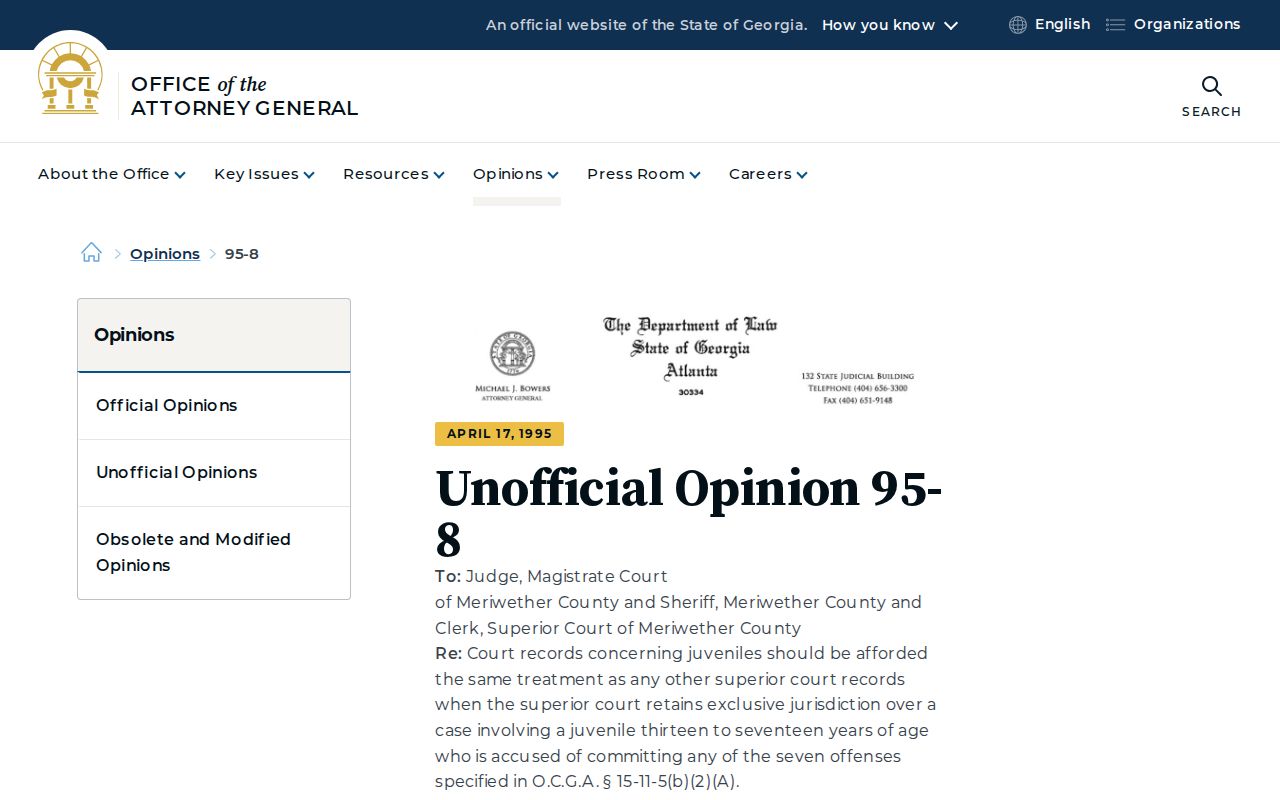
The official guidance supports one narrow conclusion. No public juvenile result does not mean no proceeding exists. It means confidentiality may control what the public sees.
O.C.G.A. § 15-11-708 generally limits public inspection of juvenile law-enforcement records. A statutory exception or court order can change that. Contact the Superior and Juvenile Clerk for the lawful access path. Never ask a commercial search service to bypass a restriction. Limited metadata is not a complete account of the case.