
Franklin County Civil Docket Searches
For a Superior civil or domestic case, start with the Franklin County Court Dockets page. From there, use Georgia Courts E-Access to reach PeachCourt. The county-linked legacy wrapper is not a dependable public form. A login redirect does not mean no case exists. Georgia Courts states plainly that a provider account is required. Once inside PeachCourt, pick Search, then Cases. Set the county to Franklin and the court to Superior, and run an exact court case number or a carefully checked party name.
Before you open the event history, confirm the basics. Check the caption, the filing date, party roles, the judge, and the status. A filing-number search works differently. PeachCourt's Filings screen looks up a Peach number, not an ordinary party name. If the Franklin County civil docket comes up empty, test spelling and case-number punctuation. Then confirm the court class, and call the correct office.
- Identify Superior, Magistrate, or Probate as the filing court.
- For Superior, select Franklin County and Superior Court in PeachCourt.
- Search the exact case number or a carefully checked party name.
- Read service, motions, signed orders, and the newest hearing entry in date order.
- Contact the clerk for an older file, an inaccessible image, or an official copy.
Franklin County Civil Docket E-Filing
Paper filing ended for most Franklin Superior civil cases on January 1, 2025. The county's civil e-filing flyer requires electronic filing through PeachCourt after that date. Temporary Protective Orders, adoptions, pauper's affidavits, and notaries are listed exceptions. Georgia Courts also marks Franklin Superior as PeachCourt Mandatory. The rule changes how papers reach the clerk. It does not make every docket image public or free.
The local self-represented filing instructions split this into two separate tasks. Opening a case is one thing. Adding a filing to an existing case is another. Expect completed and notarized forms where required, plus party details, uploaded documents, e-service choices, fee payment, and confirmation that sensitive data was redacted. PeachCourt then routes the filing to the clerk for acceptance or rejection. A clerk's rejection is not a judicial dismissal.
Do not confuse fees: Franklin's pro se guide lists a $216 filing fee, $50 service fee, $30 first filing by a party, and $5 for filings two through ten. Those are filing and service charges, not published copy fees.
Civil Dockets: What They Show
Think of a Franklin County civil docket as a dated index. The header names the court, case number, type, caption, filing date, assigned judge, and status. Party rows separate plaintiff from defendant, or petitioner from respondent. Below that, the event list records what the clerk accepted and when. Read the whole chronology before trusting the current status. Service, an answer, a motion, and a signed order each carry different weight in a court record.
| Case header | Franklin Superior Court, exact case number, case type, caption, filing date, judge, and status. |
|---|---|
| Parties | Plaintiff or petitioner, defendant or respondent, counsel, and service status where lawful and public. |
| Opening filings | Complaint or petition, civil initiation form, fee or pauper indicator, and summons. |
| Chronology | Acceptance, service return, answer, counterclaim, motion, notice, proposed order, and signed order. |
| Result | Judgment, decree, settlement, dismissal, nonsuit, default judgment, final form, or appeal. |
A proposed order is not a signed order. A hearing notice does not prove the hearing happened, either. Rely on the newest filed and signed event, then confirm any live setting with the clerk or the assigned judge's office.
Franklin County Civil Docket Entries
Service is the formal step that tells the other party an action exists. A Franklin County civil docket may list a summons and a service request. It may also show a return indicating whether delivery occurred. The self-represented instructions say PeachCourt generates summonses and some service documents. Even so, an uploaded document, an accepted filing, and completed service remain distinct events. The docket treats them as three separate things.
- Petition or complaint
- The filing that begins the civil matter.
- Return of service
- The filed account of an attempt to deliver process.
- Motion
- A request asking the judge to act or rule.
- Proposed order
- Suggested language that has no force until the judge signs an order.
- Final judgment
- The enforceable ruling that resolves the claims identified in it.
PeachCourt keeps unexecuted proposed orders out of ordinary document access. A caption may stay visible while the file image is delayed, account controlled, sealed, or otherwise unavailable. When the exact text matters, ask the clerk for the official filed item.
What Cases Fill the Civil Docket
Major civil and domestic-relations matters fill the Franklin Superior Court docket. The local filing guide covers divorce. It also covers adult and minor name changes, legitimation, and family violence filings. Civil appeals and other matters within the court's general jurisdiction land there too. Each case type builds its own sequence. A divorce docket and a general civil complaint will not contain the same forms.
- General civil complaints and major civil claims
- Divorce and other domestic-relations matters
- Adult or minor name-change petitions
- Legitimation and family-violence filings
- Civil appeals within Superior Court jurisdiction
Some related records live elsewhere. Probate Court holds exclusive original jurisdiction over wills, estates, guardianships, and involuntary hospitalization, and those are not ordinary Superior civil cases. Magistrate Court keeps its own small-claim and dispossessory files. Search the wrong court and you may see a blank result even though a public record exists.
Franklin County Magistrate Civil Dockets
Franklin Magistrate Court is the small-civil branch of the county. Its official page lists civil claims that do not exceed $15,000, plus dispossessories, garnishments, interrogatories, personal-property foreclosure, bad checks, writs, and hearings. In Georgia, a dispossessory is the court process for recovering possession of rented property. It stands as its own case type, not a Superior civil filing.
| Office | Typical records | Public route |
|---|---|---|
| Superior Clerk | Major civil, domestic, and civil appeal filings | PeachCourt, clerk counter, phone, or mail |
| Magistrate Court | Claims up to $15,000, dispossessories, garnishments, and listed writs | 7085 Highway 145 Suite B or 706-384-7473 |
| Probate Court | Estates, wills, guardianships, and other probate matters | 7085 Highway 145 Suite A or 706-384-2403 |
No single public search form spans all three offices. The county pages simply do not offer one. Franklin County's Open Records page says judicial records should be requested from the responsible court rather than through the general county request form.
Hearings on the Civil Docket
A civil setting on a Franklin County docket can take many shapes. It may show up as a notice, an e-filed court date, a scheduling order, a hearing, or a non-jury or jury trial. Franklin's pro se guide adds a useful local detail for several divorce and name-change paths. The Clerk's Office signs a party up for court. The date lands in PeachCourt, and notice goes out by mail. Scheduling can happen one to three days after filing.
The assigned judge matters too. The clerk handles scheduling for matters assigned to Judge Phelps or Judge NeSmith. Judge Wasserman's office, by contrast, sets its own dates. Judges of the Northern Judicial Circuit travel across five counties. So read the newest setting and the assigned judge together. A reset is not a final result.
Two other calendars can mislead you. Franklin County's general CivicEngage calendar is not a civil case calendar. The Justice Center public-meeting schedule is not one either. If a date is missing, doubled, or already past, call the Superior Clerk at 706-384-2514 or the assigned judge's office. Compare any mailed or e-filed notice against the latest signed order.
Franklin County Civil Docket Copies
Three things serve three different needs. A docket lists the events. The file-stamped complaint, answer, motion, or order is the document behind the entry. A certified copy adds the clerk's authentication. PeachCourt notes that some file-stamped images take minutes to retrieve at the courthouse. They may require registered access.
A January 2025 flyer from Franklin offers one clear option. The public can visit the Clerk's Office and view the official record of a non-sealed case at no cost. That promise does not mean free remote downloads. The certified-copy charge, identification requirement, payment method, and turnaround are not published. So confirm those terms with Heather Vaughn Hill's office at 9592 Lavonia Road before ordering.
Older Superior records may need a counter visit. Or they may need a mailed request to PO Box 70, Carnesville, GA 30521. Include the court, case number, document name, and filing date if known. For an estate or guardianship, use Probate Court rather than the Superior civil channel.
Who Can See Civil Dockets
Civil court records in Franklin County Superior Court are ordinarily open for public inspection. The case must not be sealed. Uniform Superior Court Rule 21 begins with public availability. It allows a limit only when privacy harm clearly outweighs the public interest under the rule's process. Rule 36.17 requires sensitive information to be protected in electronic filings. Expect adoption documents, sealed filings, protected identifiers, and unexecuted proposed orders to be missing from ordinary online access.
For the state access-law context that applies in Franklin County, the Georgia Attorney General's Open Government Law page lays out the statute.
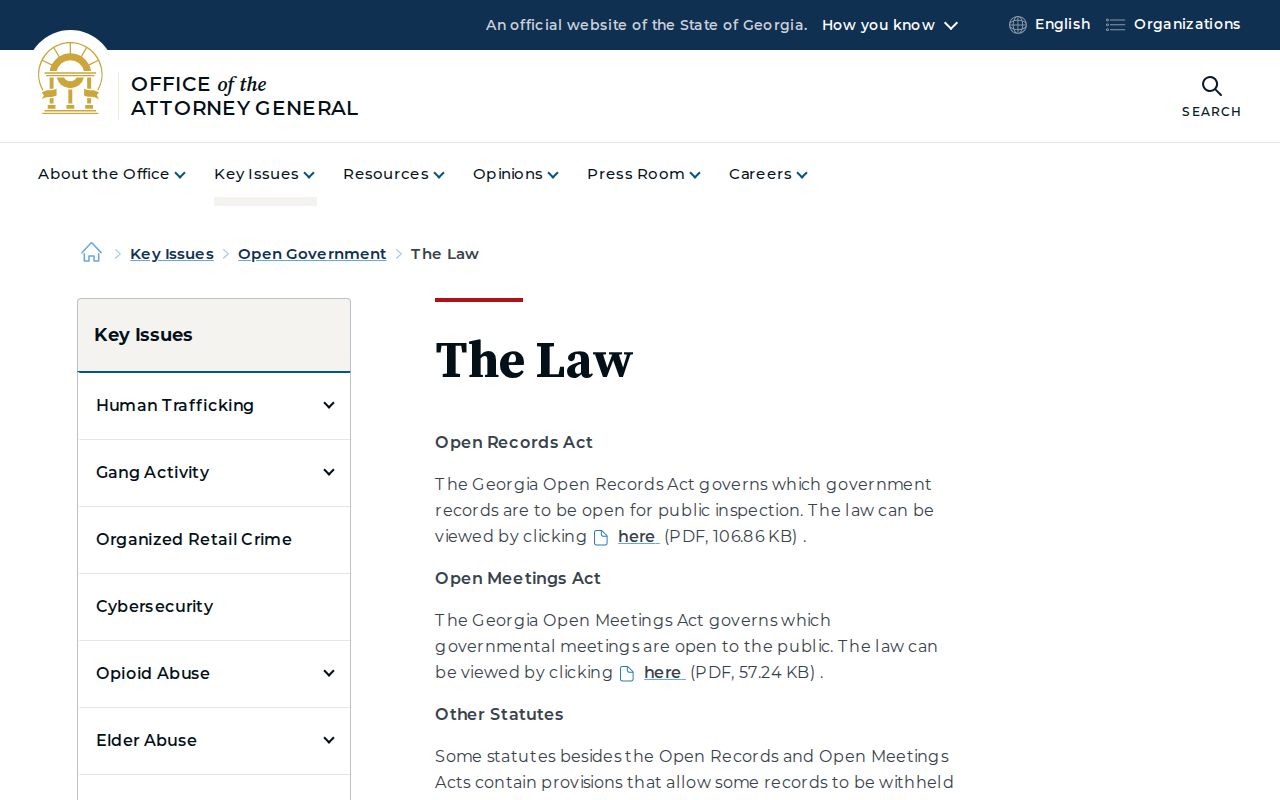
State guidance leans toward open access. Franklin's county page, though, directs judicial record requests to the court that keeps the file. The general county Open Records form is no substitute for the Superior, Magistrate, or Probate clerk.
Access rule: O.C.G.A. § 50-18-70 favors prompt public access, while court rules and specific laws still protect sealed files and sensitive data.
Franklin County or Federal Civil Docket
A dispute tied to Franklin County may belong in federal court instead. Franklin sits in the Athens Division of the U.S. District Court for the Middle District of Georgia. Federal civil dockets run on PACER and CM/ECF, not PeachCourt. The two systems never share data. So a blank county result should prompt a jurisdiction check whenever federal filing is plausible.
The Middle District records and copies page explains what federal electronic records it covers and how to get copies.
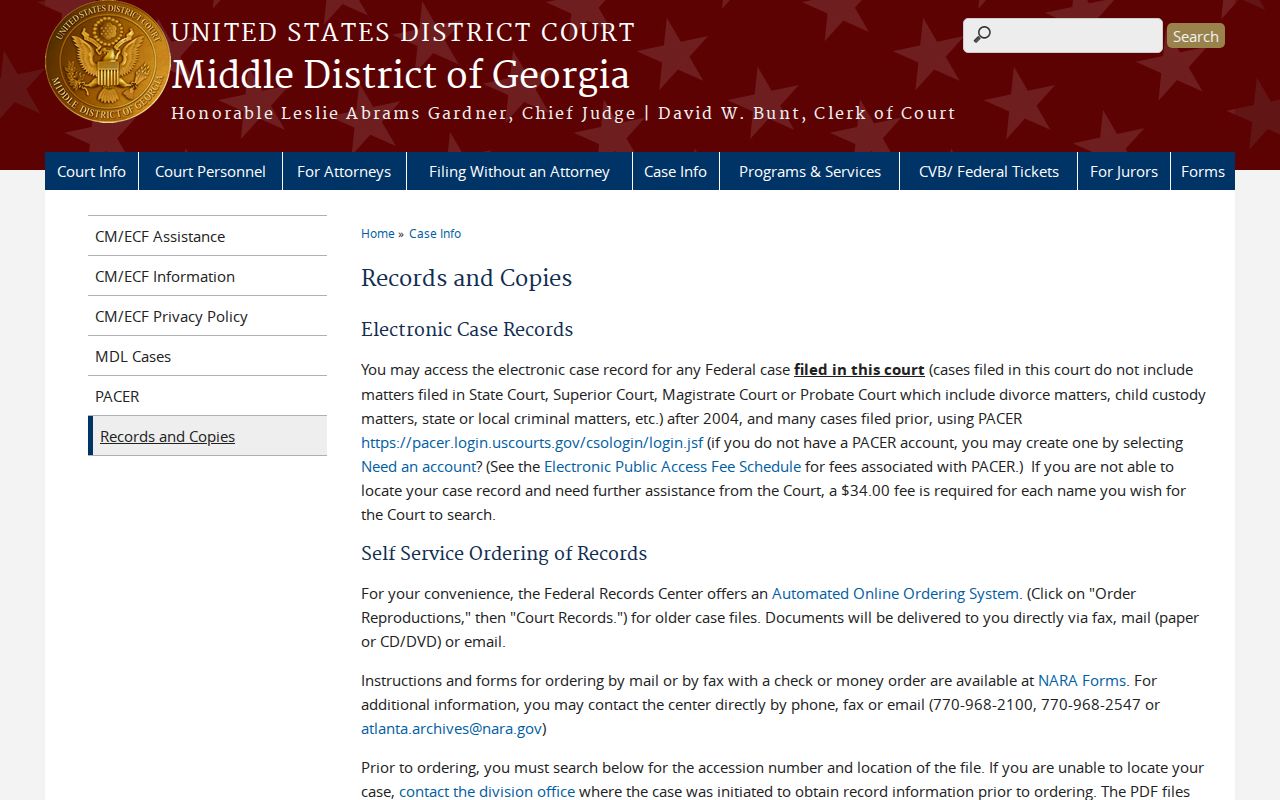
Use the federal source as a comparison point only. It does not replace the Franklin Superior Clerk for a Georgia civil case, and PeachCourt does not replace PACER for an Athens Division federal matter.
Start with the court name on the complaint, summons, or notice. A Franklin Superior caption points to the county clerk and PeachCourt. A U.S. District Court caption points to the Middle District and PACER. Matching the jurisdiction to the right office prevents wasted docket searches and misdirected record requests.